
Quick Answer: For most Texas State students, TXST on-campus vs. off-campus housing comes down to timing and budget. On-campus living is required your first year and bundles rent, utilities, and a meal plan into one academic-year bill. Off-campus apartments in San Marcos usually cost less per person each month and hand back your schedule and your kitchen.
Choosing between TXST on-campus vs. off-campus housing is one of the first big calls every Texas State student makes. The math shifts depending on your year in school, your budget, and how close to campus you want to be. Serving students across San Marcos, The Lanes at Oslo sits in the off-campus column with studio and one-bedroom floor plans built for focused living.
TXST On-Campus vs. Off-Campus Housing: What's the Difference?
The difference in TXST on-campus vs. off-campus housing is who controls your lease, your meals, and your walk to class. On-campus means a residence hall or university apartment on a fixed academic-year contract. Off-campus means a private apartment in San Marcos, usually on a 12-month lease, with your own kitchen and your own rules.
There's a catch before you even choose. Texas State requires students who finished high school within the previous 12 months to live in on-campus university housing. If you're a freshman, the decision is mostly made for you. Everyone else, sophomores through grad students, gets to weigh both sides honestly.
| Factor | On-Campus Housing | Off-Campus Housing |
|---|---|---|
| Typical cost | Residence hall double from $3,660/semester; university apartments $4,215 to $6,190/semester | Shared San Marcos apartments often $600 to $1,135 per person each month |
| Lease length | Full academic year, about 9 months | Usually a 12-month lease |
| Meal plan | Required in residence halls | Optional, you cook your own |
| Furniture and utilities | Included in the rate | Included at many student communities, varies elsewhere |
| Distance to class | On campus, walkable | Varies; many communities run a shuttle |
Is On-Campus or Off-Campus Housing Cheaper Near TXST?
Off-campus housing near TXST is often cheaper per person, but the real answer depends on room type and roommates. A residence hall double runs $3,660 per semester before the required meal plan gets added. Split a shared off-campus apartment four ways and your slice can fall well below that.
On-Campus Costs: Texas State Apartments on Campus and Residence Halls
Texas State publishes rates per student, per semester. For Fall 2026 through Spring 2027, a community-bathroom double starts at $3,660, in-suite doubles run about $4,480, and single rooms reach $5,325 to $5,920. Texas State apartments on campus, the Balcones and Cypress communities, are reserved for upper-division students and range from $4,215 for a four-bedroom loft up to $6,190 for a one-bedroom.
Then the meal plan. Residence hall students must buy one, and recent plans ran roughly $2,100 to $2,425 per semester. Swipes reset every week and don't roll over, and dining dollars expire at the end of each term. Skip the selection and the university defaults you to the Gold 14 plan with 300 dining dollars. Add board to your room rate and the academic-year total climbs fast. Contracts also lock you in for the full year, with very limited cancellation.
Off-Campus Costs: Apartments in San Marcos
Listing-site data from 2026 puts the average student housing apartment in San Marcos, TX near $1,100 to $1,135 a month. Share a three or four-bedroom and your per-person rent can drop to $600 to $850, since most student communities lease by the bed. You also drop the required meal plan, so groceries replace dining dollars, and many students find that swap cheaper.
The trade-off is the longer lease. Most off-campus apartments TXST students rent run a full 12 months, so you pay through summer whether you stay or sublet. Budget guides put total monthly student living costs in San Marcos between $1,250 and $1,750 once you fold in utilities, food, and transport. One scheduling note: searches for student housing near TXST peak in February and March, so lock yours down before spring break.
Which Option Fits Your San Marcos Student Living Goals?
Your San Marcos student living decision should weigh more than the sticker price. Think about your year in school, how you like to eat, and whether you want roommates or a quiet studio. On-campus wins on convenience and built-in community. Off-campus wins on space, freedom, and a kitchen the dining hall can't match.
When On-Campus Texas State Student Housing Makes Sense
On-campus Texas State student housing is the clear pick for first-years, since the university requires it anyway. It also suits anyone who values rolling out of bed five minutes before class and never managing a utility bill. The university cites research linking residence hall living to stronger campus involvement and higher GPAs. If you'd rather not own a car or cook, the all-in-one setup earns its price.
When Off-Campus Apartments Near TXST Win
Off-campus housing for Texas State University students tends to pay off once you're past that first-year rule. Off-campus housing for Texas State students gives you private bathrooms, in-unit laundry, and a real kitchen. A studio or one-bedroom also means zero roommate conflicts and a quieter place to study.
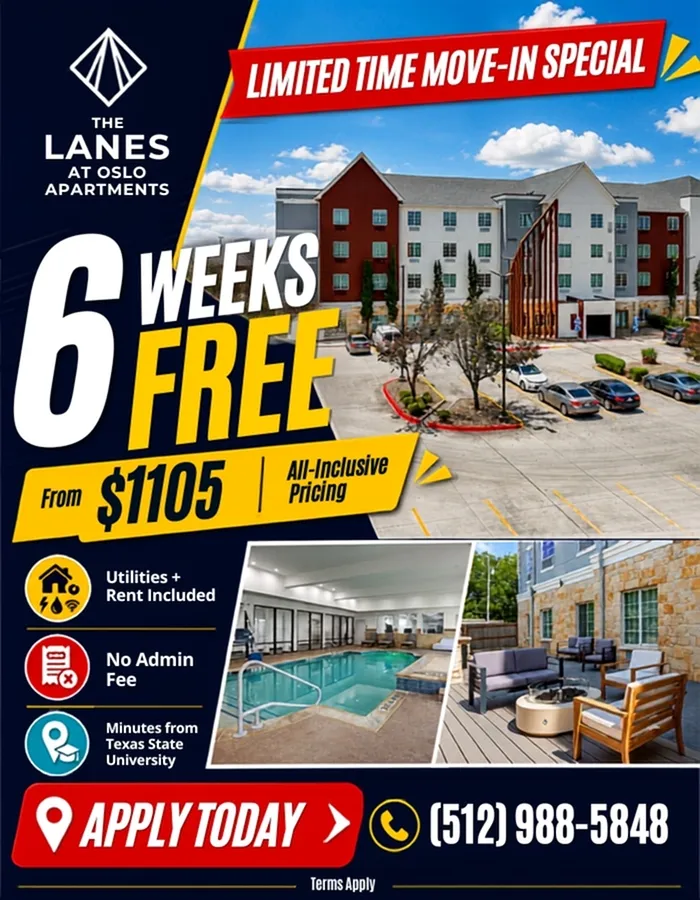
The Lanes at Oslo, a conventional community in San Marcos, leans into that crowd with studio and one-bedroom layouts aimed at focused students. Check the neighborhood map and drive times to campus, then walk through the space in the photo gallery and virtual tour before you sign anything.
Frequently Asked Questions
1. Is off-campus housing cheaper than living on campus at Texas State?
Often, yes, if you share. A residence hall double costs $3,660 per semester plus a required meal plan near $2,100 to $2,425. Split an off-campus apartment with roommates and your per-person rent can land lower, especially once you drop the mandatory dining plan.
2. Do freshmen have to live on campus at TXST?
Yes. Texas State requires students who graduated high school within the previous 12 months to live in on-campus university housing. The rule covers most first-year students. Exemptions exist for specific situations, such as commuting from a nearby family home, but you have to apply and be approved first.
3. What should I compare when choosing off-campus apartments TXST students rent?
Weigh these factors before you sign an off-campus lease near campus:
- Per-person rent and which utilities are included
- Lease length, since most run a full 12 months
- Distance to campus or shuttle access
- Furnished versus unfurnished units
- Roommate matching if you're leasing a shared unit
4. Can you cook in a Texas State residence hall?
Sort of. Residence halls include community kitchens, but the rooms aren't built for daily cooking and dishwashing, which is part of why the university requires a meal plan. Most on-campus students lean on the dining halls and retail spots. A private off-campus apartment gives you a full kitchen of your own.
5. When should I start looking for off-campus housing in San Marcos?
Start early. Searches for off-campus housing in San Marcos climb in January and peak through February and March, so aim to sign before spring break. One and two-bedroom units fill fastest. Touring in the fall for the next academic year gives you the widest pick of floor plans.
Conclusion
The TXST on-campus vs. off-campus housing question rarely has one tidy answer. First-years in San Marcos live on campus by rule and enjoy the convenience. Upper-division students usually save money and gain space off campus. Run your own numbers across a full academic year, factor in the meal plan, and picture your daily routine. If an off-campus studio or one-bedroom near Texas State fits your plans, you can start an application with The Lanes at Oslo and claim your spot for next term.