Introduction
Texas State University attracts 38,000+ students to San Marcos. Most undergraduates live off-campus in apartments near the university. Finding the right rental property can determine your college experience—balancing academics, social life, and financial responsibility.
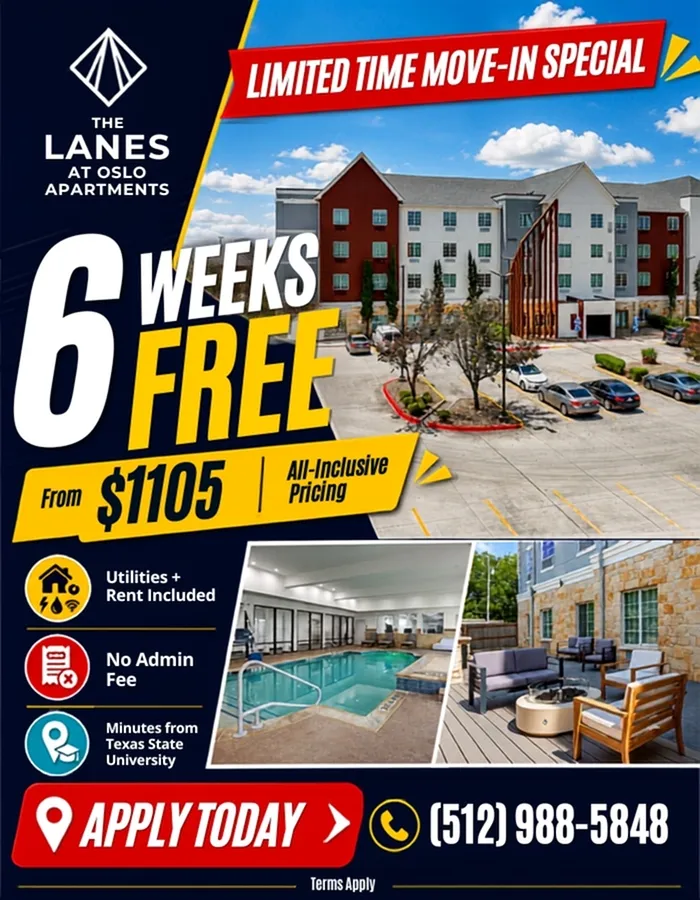
Unlike general apartment shopping, student housing requires different considerations. Landlords cater to students, offering shorter leases and more flexible terms. But navigating these options requires asking the right questions. If you're evaluating The Lanes at Oslo or similar student communities, this guide helps you evaluate properly.
---Understanding Texas State's Location and Campus
Where Texas State Is Located
Texas State University sits in central San Marcos, a college town 30 miles south of Austin and 45 miles north of New Braunfels. The city of San Marcos (65,000 residents) exists largely to serve the university. If you're comparing regions, New Braunfels offers different lifestyle options and apartment choices.
Campus Layout
Texas State's main campus spans roughly 1,600 acres. Key areas:
- North Campus: Residence halls, student center
- Central Campus: Academic buildings, library (Evans Library)
- South Campus: Athletics, parking areas
Distance Considerations
Walking distance from campus: Many apartments are 0.5–2 miles from nearest academic buildings. Shuttle buses and biking bridge most gaps.
---Key Question 1: How Close Is the Apartment to Campus?
Walking Distance (Under 0.5 Miles)
Very rare for off-campus apartments. Most dorms and residential villages are within this range. Few commercial apartments can compete with on-campus proximity.
Bike Distance (0.5–1.5 Miles)
Ideal for Texas State students. San Marcos is bike-friendly with trails and bike lanes. You can bike to campus in 5–10 minutes. The Lanes at Oslo falls into this range.
Question to ask: "Is the apartment on a safe bike route to campus? Are there bike racks at the property?"
Shuttle Distance (1.5–3 Miles)
Still reasonable if apartment complex provides shuttle service to campus. Confirm shuttle schedule before signing. If you're considering nearby New Braunfels or San Antonio apartments, understand transit varies significantly.
Question to ask: "Does the property offer free shuttle service to campus? What are the hours? How frequent?"
Moderate Distance (3+ Miles)
Requires a car or regular Uber rides. Only acceptable if you own a car or are committed to driving. Budget $20–$40/month for ride-sharing if going carless.
Red flag: If you need transportation to campus and the property doesn't offer shuttle service, ensure parking is available and convenient.
---Key Question 2: What Utilities Are Included, and How Much Will I Pay?
Typical Student Budget
Most Texas State students share apartments with roommates. Costs vary:
- 4-bedroom apartment split 4 ways: $300–$400/person rent + utilities
- 3-bedroom apartment split 3 ways: $400–$500/person rent + utilities
- 2-bedroom apartment split 2 ways: $500–$700/person rent + utilities
What to Ask About Utilities
- "Which utilities are included in rent: water, electricity, gas, trash, internet?"
- "What is the average utility bill for other residents during summer? Winter?"
- "Are roommates required to split utilities equally, or does the landlord meter individually?"
- "Is there a utility deposit or cap?"
Hidden Utility Costs
Students often underestimate utility costs:
- Electricity (summer with AC): $40–$80/person monthly
- Water (not included): $15–$25/person monthly
- Internet (high-speed for online classes): $40–$70/month (split among roommates)
Budget tip: Ask current residents or alumni about actual bills. Landlords' estimates are often low.
---Key Question 3: What Is the Lease Term, and Can I Break It Early?
Standard Student Leases
Most properties near Texas State offer flexible terms:
- 12-month lease: August to August (covers 4 semesters)
- Academic year lease: August to May (9 months, most student-friendly)
- Semester leases: Rare but sometimes available
Critical Question: Early Termination
Students move frequently due to graduation, job offers, family circumstances. Ask explicitly:
- "What happens if I need to break my lease early?"
- "Is there an early termination fee? How much?"
- "Can I find a replacement roommate to take over my lease?"
- "If I find a replacement, do I owe anything?"
Why This Matters
Students are unpredictable. You might graduate early, drop out, or need to move home. Early termination clauses should allow escape routes without losing thousands. Some properties don't penalize if you find a replacement; others charge 1–2 months' rent.
Red flag: Any property that won't discuss early termination terms is suspicious. Avoid it. When evaluating any apartment lease, understand all termination options.
---Key Question 4: What Are All the Fees, Including Hidden Ones?
Common Student Housing Fees
| Fee Type | Typical Amount | Negotiable? |
|---|---|---|
| Application Fee | $25–$75 | Sometimes |
| Security Deposit | $300–$600 | Usually not |
| Pet Fee (if applicable) | $200–$500 | Rarely |
| Monthly Pet Rent | $20–$50 | No |
| Parking Fee | $20–$60/month | Sometimes |
| Amenity Fees | $15–$40/month | No |
| Late Payment Fee | $50–$100 per late payment | No |
Total Move-In Example
For a 4-bedroom apartment, each student might pay:
- Application fee: $50
- Security deposit: $400 (split: $100/person share of total)
- First month's rent: $350
- Total due at signing: $500/person minimum
Questions to Ask
- "What is included in the total monthly rent? What costs extra?"
- "Are parking fees mandatory, or are they optional?"
- "What amenity fees apply, and can I opt out?"
- "Is internet included, or is it separate?"
Key Question 5: What Are the Lease Rules About Roommates?
Roommate Assignment
Ask how roommates work:
- "Can I choose my roommates, or are they assigned?"
- "If I want to move in with friends, can we request to be placed together?"
- "What if a roommate moves out mid-lease? Do I have to pay their share?"
Roommate Conflicts
Student housing often involves roommate issues. Ask the landlord:
- "What's your policy if roommates aren't getting along?"
- "Can I request a different roommate?"
- "If my roommate breaks the lease, am I liable for their rent?"
Why This Matters
Roommate relationships directly affect your college experience. Poor compatibility leads to misery. Good properties mediate roommate disputes; bad ones make you personally liable for absent roommates' rent.
Red flag: Any lease making you personally liable for all rent (even if a roommate disappears) is dangerous. Avoid it.
Key Question 6: Is the Neighborhood Safe, and What About Noise?
Student Neighborhood Dynamics
College town neighborhoods fluctuate between party-central and quiet residential.
Questions to Ask
- "Is this a party-heavy complex, or is it quieter?"
- "What are noise policies, and are they enforced?"
- "Have there been noise complaints or police calls?"
- "Are there quiet hours? What times?"
- "Is the neighborhood safe to walk at night?"
Visit at Different Times
Tour apartments on a weekday afternoon (quiet) and Friday night (realistic student activity level). This reveals the true environment.
Parking Safety
Ask about parking lot lighting and security. Student apartments have high car break-ins. Secure parking (covered, gated, or well-lit) prevents theft.
Key Question 7: What Maintenance and Repair Response Times Can I Expect?
Common Student Housing Issues
- AC/heating breakdowns (urgent in summer/winter)
- Plumbing issues (leaks, clogs)
- Electrical problems
- Appliance failures (stove, oven, washer/dryer)
What to Ask
- "What is the average maintenance response time for routine requests?"
- "How do I submit maintenance requests? (app, phone, online portal?)"
- "Is there 24-hour emergency maintenance? For what issues?"
- "If my AC breaks in summer, when will it be fixed?"
Why This Matters
San Marcos summers are hot. AC failure in July/August makes the apartment uninhabitable. Properties should respond within hours, not days. Check reviews or ask current residents about maintenance responsiveness.
When comparing different Texas cities and apartments, maintenance quality significantly impacts your living experience.
Neighborhoods Near Texas State University
North of Campus (Downtown/College Street Area)
Walking/biking distance to campus (0.5–1.5 miles). More walkable to shops and restaurants. College Street has student-focused apartments.
Pros: Convenient to campus and downtown entertainment
Cons: More expensive, higher noise/party activity
West of Campus (The Lanes Area)
1–2 miles from campus. Quieter, residential feel. Requires biking or shuttle. The Lanes at Oslo represents this area.
Pros: More affordable, quieter living environment
Cons: Less walkable to off-campus entertainment
East of Campus
Various distances. Range from walkable to requiring transportation.
Common Student Housing Mistakes to Avoid
1. Choosing Based Only on Price
The cheapest apartment isn't best if you spend $30/month on Ubers to campus or if maintenance takes weeks to fix problems.
2. Not Reading the Lease
Students rush. They sign without reading. Then they discover hidden fees, strict noise policies, or impossible early termination terms. Read everything. Understand what to ask before renting any apartment.
3. Leasing With Non-Serious Roommates
You're jointly liable if roommates don't pay. Choose roommates carefully. Don't sign with someone just because they're your best friend—good friends can be bad roommates financially.
4. Ignoring Moving-Out Costs
You'll owe move-out deposit returns, potential damage charges, and cleaning fees. Budget $200–$500 for move-out even with perfect care.
5. Forgetting About Summer Plans
Most 12-month leases don't pause in summer. But students leave town for internships/home. Ask if apartments offer summer subletting options. Some allow sublets; others prohibit them.
The Lease Signing Checklist
Before signing any student housing lease:
- ☐ Confirm distance to campus and transportation options
- ☐ Know all utilities included and estimate true monthly costs
- ☐ Understand lease term and early termination penalties
- ☐ Know all fees: application, security deposit, parking, amenities
- ☐ Confirm roommate assignment and conflict resolution policy
- ☐ Understand noise policies and neighborhood character
- ☐ Confirm maintenance response times (especially AC/heating)
- ☐ Decide furnished vs. unfurnished preference
- ☐ Read the entire lease (don't skim)
- ☐ Ask current residents about their experience
- ☐ Get everything in writing
FAQ: Texas State Student Housing Questions
Q1: Should I live on-campus or off-campus?
Freshmen typically live on-campus (required). Upper-classmen usually move off-campus for more independence and often lower costs. Off-campus apartments near Texas State average $300–$500/person with 3–4 roommates versus $800–$1,200/semester on-campus. Off-campus is typically cheaper after freshman year.
Q2: Can I get a summer sublease near Texas State?
Many student apartments allow subletting in summer to visiting students or non-students. Some prohibit it. Ask explicitly. Summer subletting can recover 2–3 months of rent while you're home.
Q3: What's a typical budget for a Texas State student in San Marcos?
Budget $900–$1,400/month for rent (split with roommates) plus $100–$150 for utilities, $150–$250 for food, $50–$100 for transportation. Total: $1,200–$1,900/month depending on choices. This varies significantly by living arrangement and lifestyle.
Q4: Are pets allowed at student apartments near Texas State?
Many allow pets but charge one-time fees ($200–$500) plus monthly pet rent ($20–$50). Some don't allow pets at all. Ask before assuming. Read pet policy carefully (weight limits, breed restrictions, number of pets allowed).
Q5: What should I do if my landlord won't fix something broken?
Document the issue with photos and dates. Send written request for repairs. Texas law requires habitable living conditions. If landlord ignores requests, contact Texas State University off-campus housing office or student legal services.
Q6: Should I buy or rent furniture as a Texas State student?
Rent or buy used furniture. New furniture is expensive and hard to transport after graduation. IKEA or Wayfair cheap furniture works for a year. Craigslist/Facebook Marketplace used items are even cheaper. At graduation, donate or sell rather than keep.
Conclusion
Renting near Texas State University requires different questions than typical adult apartment hunting. Student housing moves fast—popular properties rent within weeks each spring. Properties near campus fill quickly with students.
The key is asking these eight critical questions before signing: distance to campus, utility costs, lease flexibility, fees, roommate policies, neighborhood character, maintenance responsiveness, and furnished/unfurnished preference. Properties like The Lanes at Oslo cater to student needs with flexible leases and shuttle service. Evaluate every property individually using this checklist.
Your college experience depends partly on where you live. Choosing wisely—asking the right questions upfront—ensures your apartment supports your academic success and social life rather than creating constant stress.